
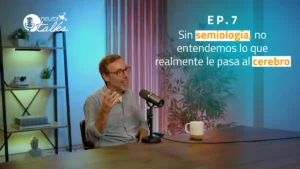
¿Te ha interesado nuestra entrevista con Saül Martínez-Horta en NeuronUP Talks? En este artículo compartimos la bibliografía recomendada por este neuropsicológo clínico para seguir profundizando en la semiología neuropsicológica y el pensamiento clínico en la evaluación del cerebro humano.
Quién es Saül Martínez-Horta
El Dr. Saül Martínez‑Horta es neuropsicólogo clínico e investigador con base en Barcelona, donde desarrolla su labor en la Unidad de Trastornos del Movimiento del Servicio de Neurología del Hospital de la Santa Creu i Sant Pau y en el Institut de Recerca Sant Pau.
Su trayectoria combina más de 15 años de experiencia clínica, evaluación y rehabilitación cognitiva de personas con trastornos neurodegenerativos, daño cerebral y alteraciones neuropsicológicas, con un fuerte compromiso en investigación aplicada.
Martínez‑Horta es experto en el análisis de los mecanismos cognitivos y conductuales asociados a enfermedades como la enfermedad de Huntington, párkinson y otros trastornos del movimiento, y forma parte del Grupo de Investigación en Enfermedad de Parkinson y Trastornos del Movimiento del IR Sant Pau, contribuyendo a estudios que buscan marcadores tempranos del deterioro cognitivo y en el desarrollo de estrategias de intervención basadas en evidencia para la estimulación cognitiva y la neurorrehabilitación.
Además de su actividad clínica e investigadora, es director del departamento de Neuropsicología en el Centro de Diagnóstico e Intervención Neurocognitiva de Barcelona (CDINC) y profesor asociado en la Universidad Autónoma de Barcelona, participando en la formación de nuevos profesionales en neuropsicología y neurorrehabilitación.
Su experiencia se complementa con más de 70 artículos científicos publicados, participación en congresos nacionales e internacionales y liderazgo en grupos de trabajo especializados en cognición y enfermedades neurodegenerativas.
Entrevista con Saül Martínez-Horta en NeuronUP Talks
Retomamos la segunda temporada de NeuronUP Talks con un nuevo episodio. En esta ocasión, nuestra neuropsicóloga Carolina Sastre se sienta junto al neuropsicólogo Saül Martínez-Horta para hablar sobre un tema esencial para todos los profesionales del ámbito cognitivo: cómo la semiología puede cambiar nuestra forma de evaluar.
A lo largo de esta conversación, Saül destaca que observar, escuchar y razonar clínicamente siguen siendo las herramientas más poderosas para entender los síntomas, diferenciar enfermedades y contextualizar la experiencia única de cada persona.
Aunque hoy disponemos de inteligencia artificial, biomarcadores y neuroimagen avanzada, el episodio subraya que la tecnología solo tiene valor si se combina con juicio clínico y comprensión humana.
Este episodio es una escucha imprescindible para profesionales de neuropsicología, neurología, psicología clínica o neurorrehabilitación que creen que nuestra labor no se limita a medir, sino que consiste en comprender a las personas.
Lecturas recomendadas sobre semiología neuropsicológica
Artículos científicos recomendados
- Buckner, R. L., Andrews-Hanna, J. R., & Schacter, D. L. (2008). The brain’s default network: Anatomy, function, and relevance to disease. Annals of the New York Academy of Sciences, 1124(1), 1–38.
- Buckner, R. L., & Carroll, D. C. (2007). Self-projection and the brain. Trends in Cognitive Sciences, 11(2), 49–57.
- Corbetta, M., & Shulman, G. L. (2002). Control of goal-directed and stimulus-driven attention in the brain. Nature Reviews Neuroscience, 3, 201–215.
- Fox, M. D. (2018). Mapping symptoms to brain networks with the human connectome. New England Journal of Medicine, 379(23), 2237–2245.
- Friston, K., & Kiebel, S. (2009). Predictive coding under the free-energy principle. Philosophical Transactions of the Royal Society B: Biological Sciences, 364(1521), 1211–1221.
- Friston, K. (2010). The free-energy principle. London: Allen & Unwin.
- Geschwind, N. (1965). Disconnexion syndromes in animals and man. I. Brain, 88(2), 237–294.
- Geschwind, N. (1970). The organization of language and the brain. Science, 170(3961), 940–944.
- Menon, V. (2011). Large-scale brain networks and psychopathology: A unifying triple network model. Trends in Cognitive Sciences, 15(10), 483–506.
- Menon, B. (2019). Towards a new model of understanding: The triple network, psychopathology and the structure of the mind. Medical Hypotheses, 133, 109385.
- Mesulam, M. M. (1981). A cortical network for directed attention and unilateral neglect. Annals of Neurology, 10(4), 309–325.
- Mesulam, M. M. (1990). Large-scale neurocognitive networks and distributed processing for attention, language, and memory. Annals of Neurology, 28(5), 597–613.
- Miller, E. K., & Cohen, J. D. (2001). An integrative theory of prefrontal cortex function. Annual Review of Neuroscience, 24, 167–202.
- Miller, E. K. (2000). The prefrontal cortex and cognitive control. Nature Reviews Neuroscience, 1(1), 59–65.
- Miller, E. K. (2010). Dynamic coordination of neural ensembles. Cambridge, MA: MIT Press.
- Moscovitch, M., Nadel, L., Winocur, G., Gilboa, A., & Rosenbaum, R. S. (2006). The cognitive neuroscience of remote episodic, semantic and spatial memory. Current Opinion in Neurobiology, 16(2), 179–190.
- Nadel, L., Samsonovich, A., Ryan, L., & Moscovitch, M. (2000). Multiple trace theory of human memory: Computational, neuroimaging, and neuropsychological results. Hippocampus, 10(4), 352–368.
- Posner, M. I., & Petersen, S. E. (1990). The attention system of the human brain. Annual Review of Neuroscience, 13, 25–42.
- Raichle, M. E., MacLeod, A. M., Snyder, A. Z., Powers, W. J., Gusnard, D. A., & Shulman, G. L. (2001). A default mode of brain function. Proceedings of the National Academy of Sciences, 98(2), 676–682.
- Raichle, M. E. (2015). The brain’s default mode network. Annual Review of Neuroscience, 38, 433–447.
- Raichle, M. E. (2015). The restless brain: How intrinsic activity organizes brain function. Cambridge, MA: MIT Press.
Libros recomendados
- Baddeley, A. (1986). Working memory. Oxford, UK: Clarendon Press.
- Baddeley, A. (2007). Working memory, thought, and action. Oxford, UK: Oxford University Press.
- Damasio, A. (1994). Descartes’ error: Emotion, reason, and the human brain. New York, NY: Putnam.
- Friston, K. (2010). The free-energy principle: A unified brain theory? Nature Reviews Neuroscience, 11(2), 127–138.
- Fuster, J. M. (1980). The prefrontal cortex. New York, NY: Raven Press.
- Fuster, J. M. (2003). Cortex and mind: Unifying cognition. Oxford, UK: Oxford University Press.
- Gazzaniga, M. S. (2000). The split brain revisited. Cambridge, MA: MIT Press.
- Hebb, D. O. (1949). The organization of behavior: A neuropsychological theory. New York, NY: Wiley.
- Luria, A. R. (1962). Higher cortical functions in man. London: Tavistock.
- Luria, A. R. (1973). The working brain: An introduction to neuropsychology. New York, NY: Basic Books.
- Luria, A. R. (1968). The mind of a mnemonist: A little book about a vast memory. New York, NY: Basic Books.
- Luria, A. R. (1972). The man with a shattered world: The history of a brain wound. Cambridge, MA: Harvard University Press.
- Mesulam, M. M. (2000). Principles of behavioral and cognitive neurology (2nd ed.). New York, NY: Oxford University Press.
- Milner, B. (1972). Memory and brain. New York, NY: Oxford University Press.
- Moscovitch, M., Nadel, L., et al. (Eds.). (2016). The Oxford handbook of memory. Oxford, UK: Oxford University Press.
- Sporns, O. (2010). Networks of the brain. Cambridge, MA: MIT Press.
- Sporns, O. (2011). The human connectome: A structural description of the human brain. Cambridge, MA: MIT Press.
- Shallice, T. (1988). From neuropsychology to mental structure. Cambridge, UK: Cambridge University Press.
- Tulving, E. (1983). Elements of episodic memory. Oxford, UK: Oxford University Press.
- Tulving, E. (1972). Organization of memory. New York, NY: Academic Press.
- Uddin, L. Q., Supekar, K. S., Ryali, S., & Menon, V. (2011). Dynamic reconfiguration of structural and functional connectivity across core neurocognitive brain networks with development. Journal of Neuroscience, 31(50), 18578–18589.
- Uddin, L. Q. (2015). Salience network of the human brain. London: Academic Press.
Conoce a fondo
NeuronUP
Pruébalo gratis
La plataforma que + de 4.500 profesionales utilizan en su día a día





 Estimulación cognitiva centrada en la persona: claves para personalizar la intervención neuropsicológica




Deja una respuesta